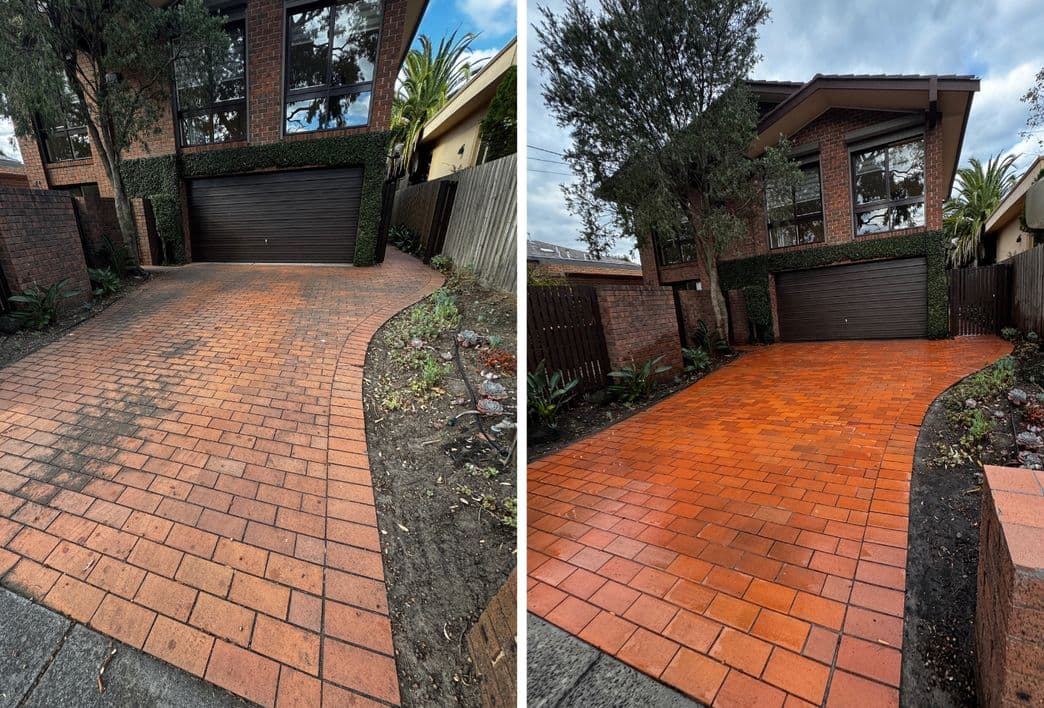
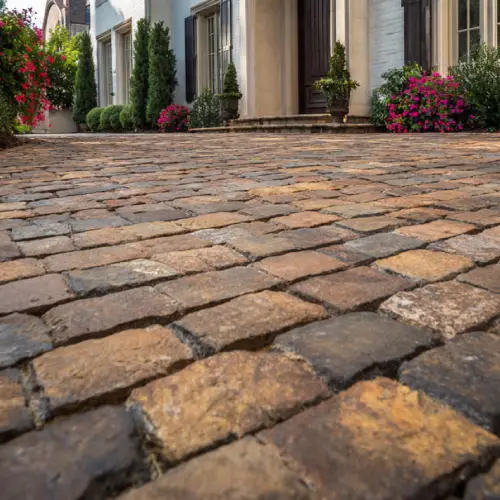
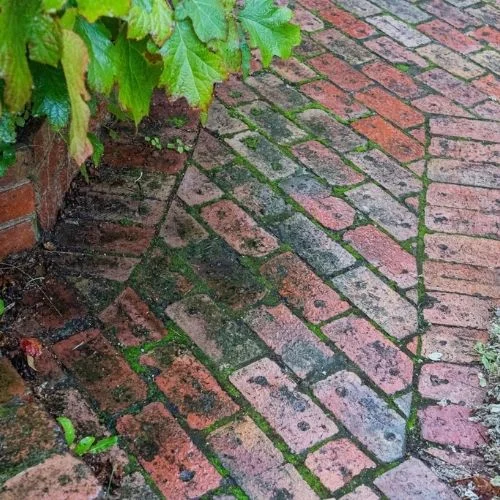
Across Melbourne, paved driveways, brick courtyards, bluestone entries, and travertine and porcelain pool surrounds all develop the same problem after a couple of winters. Mold and algae embed into the textured face of the paver, and dark organic staining settles into the joints and lines a garden hose can’t reach. Cool, wet Melbourne winters keep paving damp for weeks at a time, especially in shaded courtyards, so growth gets the conditions it needs to take hold.
Mr Sparkle Window Cleaning is the Melbourne team that genuinely restores paving. We run an industrial pressure cleaner with a flat surface cleaner attachment for an even finish, plus a chemical pre-treatment and post-treatment that lifts mould and algae out of the surface itself. Bordering gardens, lawn edges, and pool surrounds get three full rinse passes on every job. We work on concrete, brick and clay, bluestone, travertine, limestone, and porcelain, and we focus our craft on a single deliverable: a deep, even, properly restored finish.
Most quotes go out within 30 minutes to one hour, and around 90% are handled remotely. Call us today on (03) 7073 2133 to get on the schedule.
Paver cleaning sits inside our pressure washing service, alongside concrete and driveway cleaning, and follows the same pricing structure. Pricing is per job rather than per square metre or per hour, and the biggest factor is the size of the paved area.
Most paver cleans land in the $475 – $1,000 range. Standard residential paving (a paved driveway, a courtyard, or a backyard entertaining area) starts near $475, while larger or extensively paved properties move toward $1,000. A standard paved area takes around an hour, while very large or long paved driveways can run two to three hours.
A few real factors move the price within that range:
To confirm the booking, we take a 50% deposit online with no credit card fees. On a $475 paver clean that’s about $238, and on a $1,000 job it’s $500. Pricing details for your specific paving are available upon request, so call (03) 7073 2133 if you’d like a number for your property.
The quote process is built to be low-effort for you. You can call, send a message through the website, or text us a couple of photos of your paving, and we take it from there. For driveways and front courtyards, we usually pull what we need from Google Earth, Google Street View, or real estate listing photos of your property. For backyard or hidden paving, a couple of phone snaps from your end is the fastest path to a price. If you’d prefer to meet in person, quotes are free across our local service area. Current offers are confirmed at the time of quoting.
We clean the paver types most common across Melbourne homes: concrete, brick and clay, natural stone (bluestone, travertine, limestone), and porcelain. The overall process stays the same, with the technique adjusted to suit each surface.
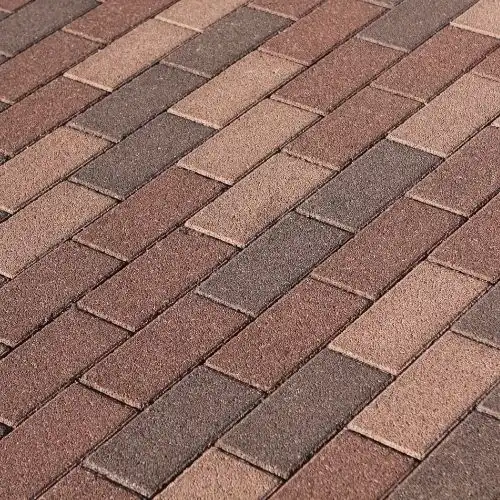
Concrete pavers are the most common type we encounter, especially on driveways, patios, and around pools. We clean them with the industrial pressure cleaner and surface cleaner attachment, paired with chemical pre-treatment and post-treatment to lift growth out of the porous surface rather than just rinsing the top layer.
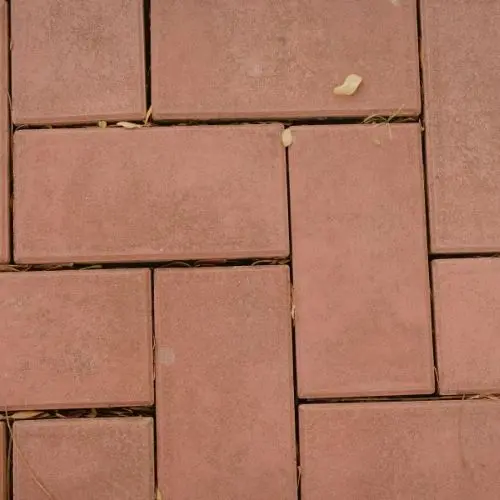
Brick and clay show up across older Melbourne courtyards, garden paths, and traditional homes. They run through the same overall process, with the post-treatment doing the heavy work on growth lodged into the textured face. Brick and clay almost always look noticeably better afterward, because the natural colour underneath the buildup comes back through clearly.
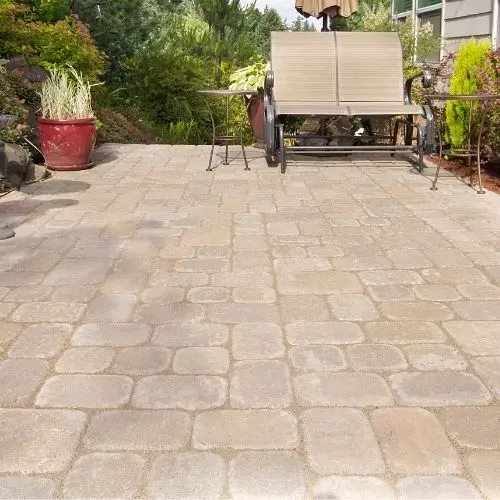
Bluestone runs across traditional driveways and entries, travertine is the favourite around pools, and limestone shows up on paths and entertaining areas. Natural stone can be more porous than concrete and may absorb stains or moisture more readily, so the team assesses the surface and uses the appropriate pressure, pre-treatment, and rinsing approach for the condition of the area.
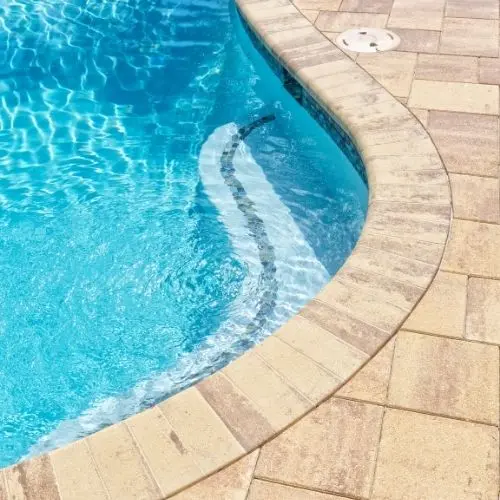
Porcelain pavers are common in newer Melbourne builds, particularly around pools and contemporary entertaining areas. Porcelain is denser and less porous than concrete or natural stone, so surface buildup tends to sit more on top than soak in. The same overall process applies, with technique adjusted to suit the smoother, harder face.
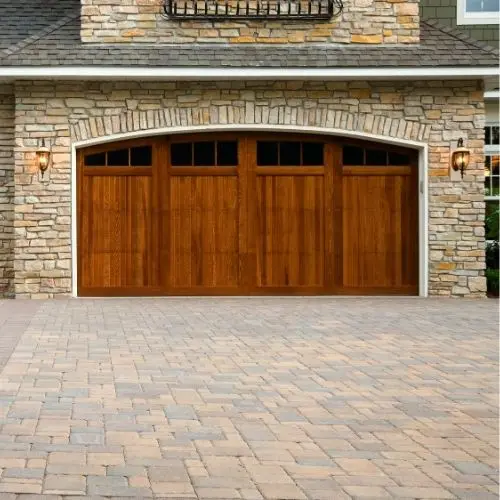
This is the question most paver customers actually want answered. The plain version: when the joint material is in good condition, the cleaning process leaves it untouched. When the grout, sand, or jointing material is already cracked, loose, washed out, or breaking apart, pressure cleaning can expose what’s already failing. We flag joint condition during the on-site walkthrough before we start, so you know exactly what to expect from the result.
Degreasers do real work on oil staining. Most marks fade noticeably after treatment, and on porcelain they often come up cleaner than expected. On concrete and natural stone, oil penetrates the porous surface, so the realistic result is a lighter, less visible stain rather than a fully erased one. We tell you that on the quote so you can decide whether the trade-off is worth it for your paving.
A few situations call for a pause before cleaning, and we’ll flag them on the quote rather than mid-job:
We’d rather flag a problem on the quote than discover one mid-clean.

So you know exactly where we stop: our work covers the cleaning side. Sealing, re-sanding (including polymeric sand), re-jointing, and restoration or colour treatments are separate trades. If any of that’s on your wishlist, we can recommend a specialist to handle it after we’ve cleaned the paving for them.
During business hours, we usually reply within one to five minutes, often within one. Most people booking a paver clean want a price quickly, sometimes before guests arrive, before listing the home, or before the entertaining season starts.

We send most paver quotes within 30 minutes to one hour, and around 90% are handled remotely. Driveways and front courtyards are easy to assess this way; for paved areas hidden from street view, we ask for a couple of phone photos. In-person quotes are free of charge in our local service area.

We run an industrial pressure cleaner, not a homeowner-grade unit, with significantly higher water volume and adjustable pressure. For paving, we pair it with a surface cleaner attachment that runs evenly across the whole paved area. No streaky wand lines, no patchy spots, and a finish that’s uniform from one side to the other.

Mould, algae, and lichen embed into the texture and joints; they aren’t just sitting on top. We apply a pre-treatment that breaks the growth down, run the surface cleaner over it, then apply a post-treatment that lifts remaining spores out of the surface. The chemistry is SH (sodium hypochlorite, also known as bleach), the industry-standard agent for organic growth on hard surfaces.

Vegetation gets a thorough rinse before any chemical is applied, again during dwell time, and once more after the paving is rinsed clean. Three rinse passes on every job. Pavers almost always sit alongside garden beds, lawn edges, planter boxes, or pool surrounds, so this matters more on paving than on most other surfaces we clean.

You’ll always know what you’re getting and what you’re not. We focus on the cleaning side, and we tell you upfront when a job needs sealing, joint repair, or a longer cure time before we touch it. That kind of clarity is rare in this trade, and it’s the reason most of our paver work comes through word-of-mouth referrals.

We’re one of the most-reviewed and highly rated exterior cleaning companies in our area, with a consistent five-star rating. Every review came from a real Melbourne homeowner who got the result they were promised on the day we said we’d deliver it.
We carry public liability insurance up to $20 million. Every job ends with a walkthrough, or a video walkthrough if you aren’t home. If anything is missed, we return free of charge. If you’re not happy with the result, we’ll give your money back. We don’t want to fight with anyone.
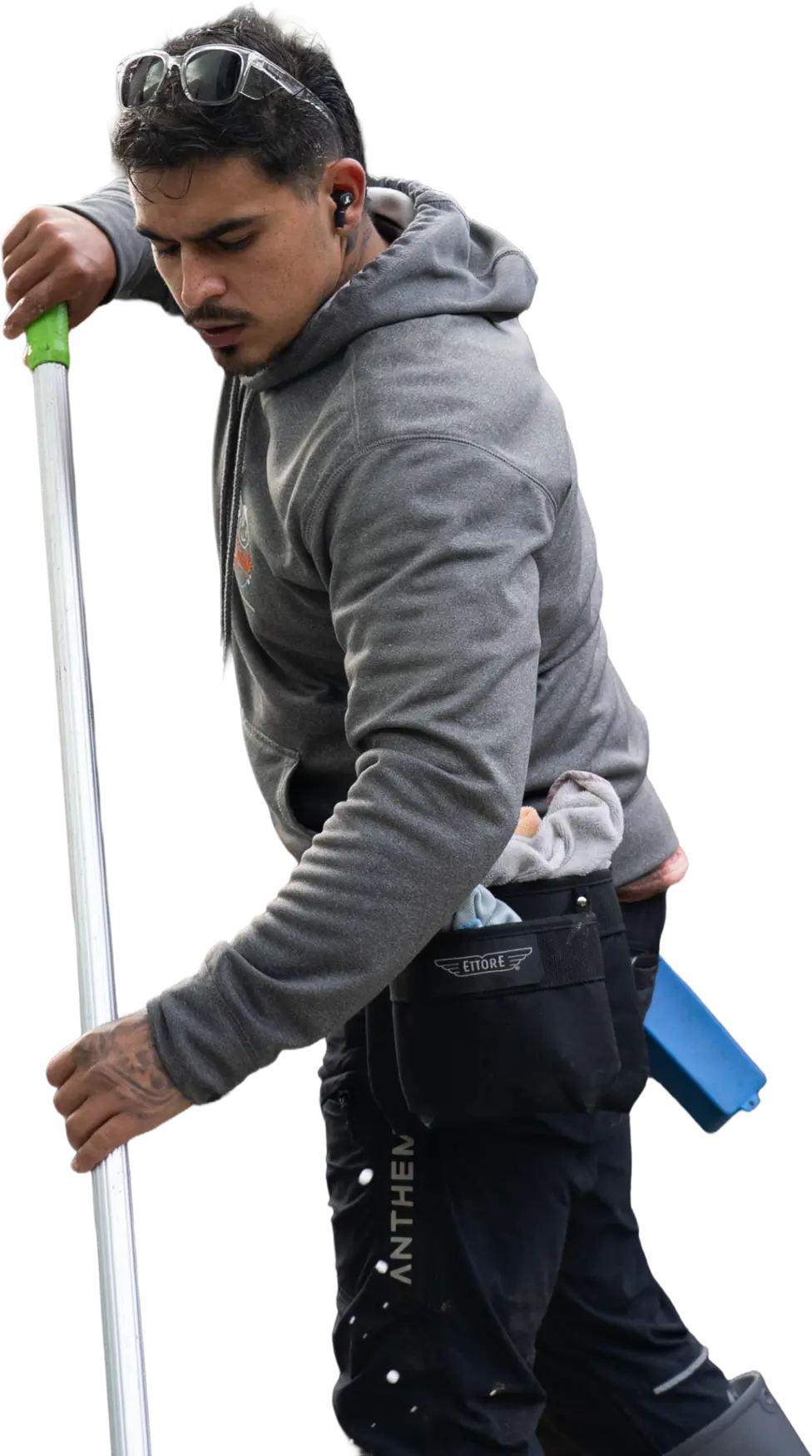
A good paver clean is staged, not rushed. Here’s how the eight parts run on a real Melbourne job.
During business hours we reply within one to five minutes (generally one), then ask a short list of discovery questions: paved area size, paver type, age of installation, level of staining, oil marks, and drainage. We then review the property remotely through Google Earth, Google Street View, and listing photos. For backyard paving, we ask for phone photos. Most quotes go out within 30 minutes to one hour.
Once you accept the quote, we lock in your preferred time and take a 50% deposit online with no credit card fees. You receive a booking confirmation immediately, then a reminder 24 hours before service. The reminder is when we ask you to move outdoor furniture, planters, or vehicles off the paved area, clear loose items, and confirm the outdoor tap is accessible.
We arrive on time and walk the paved areas with you to confirm scope and flag anything worth knowing about. We connect hoses to your outdoor tap, since our machine puts out around 30 litres per minute and the 200-litre truck tank wouldn’t last seven minutes on its own. Before any chemical touches the paving, every plant near the work area gets a thorough soak rinse.
We apply an SH-based chemical pre-treatment evenly across the entire paved area, working it into the joint lines as well as the paver face. The dwell does the chemistry work that pressure alone can’t.
The pre-treatment sits for about 10 minutes before we touch the paving with pressure. While the chemistry does its work, we go back through the surrounding vegetation with another rinse: the second of three rinse passes for plants on the same job.
Once the dwell is done, the actual cleaning begins. The industrial pressure cleaner paired with the surface cleaner attachment runs evenly across the paving. Pressure is adjusted to suit the surface in front of us. The result is an even, consistent finish, not the streaky pattern a wand leaves behind.
A single pass doesn’t reach every spore, so we apply a post-treatment across the freshly cleaned paving and let it dwell for about 20 minutes. After the dwell, we rinse the paving and give surrounding vegetation one more thorough rinse: the third rinse pass for plants.
Our team does its own walkthrough first, looking for inconsistent areas, missed corners, or runoff that needs tidying, and we fix anything we find on the spot. Then we walk you through the result. If you aren’t home, we record a video walkthrough so you can review it yourself. If you spot something later, we come back and fix it free of charge. The day after or the week after, our office team gives you a happy call to confirm everything is to standard, gather feedback, and (if you’re happy) ask for a Google review.
We don’t leave a paver cleaning job until you (or your video walkthrough) confirm you’re happy. If something needs to be touched up before we go, we touch it up on the spot. No follow-up booking, no extra trip charge.
If you notice something after we’ve left, like a corner that needs another pass or an edge along a garden bed that wasn’t fully cleared, we come back free of charge. No callout fee, no argument, no fine print buried in a service agreement.
In the rare case the result isn’t right, we refund you. The way we say it on site is the same way we mean it: we’ll give your money back, and we don’t want to fight with anyone.
We carry public liability insurance up to $20 million. The cover sits behind a careful job: thorough preparation, plant protection, surface assessment, and clear scope on every property before the equipment comes off the truck.
Honesty over the easy answer:
These boundaries are confirmed at the time of booking, so the result we promise is the result you get.
Paver cleaning sits within our pressure washing service and typically falls in the $475 – $1,000 range. Standard residential paving (a paved driveway, courtyard, or backyard entertaining area) starts near $475, while larger or extensively paved properties move toward $1,000. Final pricing depends mainly on the size of the paved area.
A standard paved area usually takes around an hour. Very large or long paved driveways can take two to three hours, especially when there’s heavy organic growth or significant landscaping to protect.
We clean the paver types common across Melbourne homes: concrete pavers, brick and clay pavers, natural stone (bluestone, travertine, limestone, sandstone, granite, marble), and porcelain pavers. The overall process is the same across these materials, with the technique adjusted to suit the texture and density of each surface.
We focus on cleaning only, with no sealing, sanding, re-jointing, or restoration. If you want your pavers sealed or the joints repaired after the clean, that’s a separate trade and we can recommend one. The cleaning side is what we do well.
When the joint material is in good condition, pressure cleaning leaves it untouched. When the joint sand or grout is already cracked, loose, washed out, or breaking apart, the cleaning process can expose what’s already failing. We flag joint conditions during the on-site walkthrough before we start, so you know what to expect.
Degreasers fade most oil staining noticeably. The realistic result on concrete and natural stone is a lighter, less visible mark rather than a fully erased one, since oil penetrates porous surfaces. Porcelain often comes up cleaner. We tell you that upfront so you know what the finish will look like.
We use SH (sodium hypochlorite, also known as bleach), the industry-standard agent for breaking down mould, algae, and organic growth on hard surfaces. The pre-treatment dwells for about 10 minutes; the post-treatment dwells for about 20 minutes. Pressure alone won’t lift growth that’s embedded into porous paving, which is why the chemistry matters.
We rinse vegetation thoroughly before any chemical is applied, again during dwell time to dilute any drift, and once more after the paving is rinsed clean. Three rinse passes on every job. Pavers almost always sit alongside garden beds, lawn edges, or pool surrounds, so this matters more here than on most surfaces we clean.
Yes. Our industrial pressure cleaner uses around 30 litres per minute, and our truck tank holds 200 litres, which is enough for about seven minutes of cleaning on its own. We connect to your outdoor tap on arrival, so we just need to know the tap is accessible.
We recommend waiting until the bedding sand and joint sand have fully set. Pressure cleaning before the joints have settled can move pavers and wash sand out, which damages the installation. We’ll ask about installation timing during the quote and recommend the right window if needed. The same caution applies to concrete pavers less than three years old.
Whether you want a one-off paver clean before guests arrive, a refresh of the pool surround before summer, or a full paving and driveway restoration before listing the home, we can have a quote in your inbox within the hour. The remote quoting process means there’s no waiting around for a site visit unless you want one, and during business hours you’ll usually hear back within minutes
Call Mr Sparkle Window Cleaning today on (03) 7073 2133 to book your paver clean, or send a quote request and we’ll be in touch within minutes during business hours.